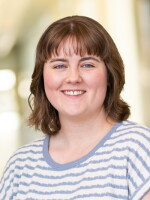
NEUFELD: Dr. Fenech, I thought we could start today just first with how long you've been working as an OB-GYN and what it all is that you do.
FENECH: Yeah, I've been an OB-GYN, like, full fledged with all my training, if you want to count my training 16 years. If you don't count my training, 12.5 years. So, I've been in Pittsburg since 2013 and have developed a very busy practice over that time frame. Practice includes everything from women in their first onset of periods and their early reproductive ages to women that are geriatric or elderly, and then everything in between. And then of course you throw into that the magic of childbirth, which is probably my favorite part of my job. So everything to do with obstetrics and care during pregnancy is one of the things that I cover as well.
NEUFELD: What made you choose Pittsburg?
FENECH: It's where I met my wife back in 2003 or 2004. I was a senior at Pitt State, and my wife and I met in choir. We started dating, I went to medical school and luckily everything worked out. So when I was in residency, we started looking at places where I could ultimately practice and we could raise our kids, and we loved Pittsburg, so we decided to come back home to Pittsburg. She's originally from Independence, and I'm originally from Neodesha, Kansas. I knew Neodesah wasn't a big enough town to support an OB-GYN, and same thing with Independence. So that's why I ended up coming back to Pittsburg, because I was excited about being close to the Gorillas and seeing football and all the sports that I went to college and saw. I thought it'd be really cool to be back in the community.
NEUFELD: Yeah. So you are an OB-GYN here in Pittsburg, but I know there's also probably, like, nurse practitioners and then also you got like your family doctors. So what is the differences in your work and then what's the benefits of having all of those types of care?
FENECH: When it comes down to women's health, there are a lot of different types of providers that can take care of women. And what makes a difference is the training. So when you talk about a nurse practitioner or physician assistants, they typically have a four year undergraduate degree and then they nowadays either have a three or four year postgraduate degree, which would be the equivalent of a master's, in some cases a doctorate. Basically the difference is that they get a lot of clinical side and still get some of the same science training, but not quite as in-depth as you would, let's say, if you're if you're going to medical school.
So flip that to medical school, if you have four years of undergraduate and then you go four years of medical school, those first two years of medical school, I would say would be equivalent to about four, sometimes five years of regular undergraduate hours. So we're talking like 160 hours worth of book work or academic work crushed into two years, the first two years of medical school. So it's pretty intense, right? And then the last two years are clinical. I have clinical medical students that follow me around, so they basically get to see how all of the education that they've learned in the textbooks translates into real medicine. After medical school, you kind of choose, you kind of get told where to go based upon you know, your grades and your standing and your competitiveness. So a family practice doctor’s typically going to go to a three year residency program. What that means is that they get to practice medicine, write prescriptions, take care of patients, make decisions according to their care, with the supervision of a fully fledged board-certified physician watching over them. So that's a three year program. And with family practice, it covers everything from pediatrics to gynecology to obstetrics to geriatrics. So basically anyone and everyone, male or female, throughout their entire life, versus an OB-GYN residency, we really focus in our residencies on procedures and deliveries just because those are the highest risk things that we're going to encounter whenever we come out of training.
So our training is four years long. So it's one extra year than a family practice doctor, and we literally do nothing but women's health. We really focus on safety in childbirth, taking care of women during pregnancy, and, if needed, surgical interventions that women might need in their life like hysterectomies, removal of ovaries, cancer screenings and cancer removals. So those are kind of the big differences. Obviously, the higher up in training that you become, the less there are of you to take care of people. Right? Because there's just not as many spots, and because it's so competitive to get in those spots. A town like Pittsburg is lucky if we can get two, three —four would be glorious— but if we could get two or three OB-GYNs in this town, that's probably enough to take care of everything that's coming through. Now, we can't be everywhere at once, and so we really do need the family practice doctors to kind of step in and look through these patients that might not need to see an OB-GYN, but be able to determine if they do or not and see if it’s beyond their scope of practice, and then they need our help. The same thing with these nurse practitioners and physician assistants. They do a good job in screening the general community for people that need our higher level of care. So that's where I feel like we all kind of play a part and work together. Without them, there's no way I would be able to split myself in enough places at once to take care of everybody. So it's nice that we can work together as a team.
NEUFELD: Even though Pittsburg is small, I would assume you still get a good number of patients from the surrounding areas of Pittsburg, so I would assume it helps with those patients as well.
FENECH: Absolutely. Because Fort Scott, Baxter Springs, Galena, Parsons, those are all communities that if they did have OB-GYNs, they've lost them recently. And so they have nurse practitioners there and family practice doctors there that will see patients that need their routine screening and whatnot. But if something's picked up on routine screening, they can easily refer them to us here. I've seen patients as far as from Chanute, Neodesha, Fredonia, Independence, even over into Missouri on that side, Nevada, Lamar. And they need somewhere to go as well.
NEUFELD: So switching topics just a little bit, I know March is endometriosis awareness month, so I thought we could talk a little bit about that as well. First, just starting off with what exactly is endometriosis and how does it affect people?
FENECH: That's a very big topic. It's affected women for years, and we've really struggled with trying to get a handle on it. So the first step in endometriosis is understanding what it is. And endometriosis is the presence of endometrial tissue, which is that lining inside of a woman's uterus that gets shed every month. So it’s the presence of that tissue outside of the uterus itself. There's lots of theories as to what causes endometriosis, but nothing has been defined as the accepted, across the board, this is what happens with every single patient. So it's hard to say exactly why, but some women seem to have a genetic predisposition to endometriosis. Some women will just get it, even though nobody else in their family has had it as well. What it does is it causes severe pain. Typically it's pelvic pain. It can cause pain with intercourse, and very painful periods. To the point where, not just like a typical painful period like, ‘I feel crampy’ but debilitating, like, can't get out of bed, spend the whole day with a heating pack over their abdomen, can't work, can't function, can't go to school. So those are the typical types of symptoms that we see with endometriosis.
NEUFELD: How has, like, what you and other doctors know about endometriosis, how have you seen that change over the years you've been working?
FENECH: There's been updates as far as treatment methods and treatment modalities that have made it a lot, I'm not going to say easier to treat, but a little bit more convenient to treat. Because prior to probably the early 2000s, definitively, treatment for endometriosis was either menopause, so you either waited it out and just toughed it out until you hit menopause and then that lining stopped shedding and the pain goes away, or getting a hysterectomy before then. And that's no fun either. That's a big surgical procedure, and a lot of times we have to take the woman's ovaries, because if we don't, the endometriosis and the pain continues to bother them, even though there's no uterus there. More recently, probably in the past ten years, there have been oral medications now that we can use that help subside some of those —as well as injections as well— that will help subside some of those symptoms. So women that would, say, you know, 20 years ago in their 20s would have had severe pain, they might have said, ‘I've given up on having kids because this pain is too bad, and I just want a hysterectomy.’ Well, now it's given those women an extra ten, 15, sometimes even 20 years to buy us time, allow those women to have kids if they want to one day and not tell them that their only option is to have a hysterectomy.
NEUFELD: Has there been ways that the general public's awareness of endometriosis has grown in the same time that you've been working?
FENECH: I think so. You know, with the growth of social media, TikTok —I kind of roll my eyes at TikTok— but a lot of people do get good information. Not all good information, but some good information, at least enough to start the conversation. And that's I think the most important thing, is a lot of people were ignoring it for years because it was kind of taboo to talk about your period or taboo to talk about this or that or the other. Well, TikTok and these Facebook reels, they're giving a form for people to kind of express what they're going through. And this is a good thing in the aspect that a lot of people see this and think, well, I'm not the only one. So that's a really good thing that I think has come up that’s helped people at least bring it up to me more often than they would have. Otherwise, they just think they have normal, painful periods.
And then of course, if you watch any type of television, I think it's funny, but the things that they advertise on television, pharmaceutical companies, some of them have been targeted towards endometriosis. Like, Orilissa is one of the medications that's targeted towards endometriosis, and I've seen a few commercials for that. It's very ominous. They're like, ‘Ask your doctor if you have painful periods, could you have endometriosis?’ Well, just asking that question sometimes prompts us to find it.
NEUFELD: How do you work with patients here in Pittsburg that have endometriosis?
FENECH: Well, there's kind of a step by step treatment method, and it kind of depends on the severity. So, typically I would start with trying to suppress your period from coming because honestly, women that have endometriosis typically are on their worst days when they have a period. So if we can get their periods at least to kind of hide away for two, three, four, six months, that's a good starting point, at least buys us time. That's not always effective using traditional methods. So traditionally we'd use things like a birth control pill, or a birth control shot called Depo-Provera that would stop periods, for a specific period of time. And if we couldn't get periods of stop or the pain was still breaking through beyond that, then we sometimes will have diagnostic surgical techniques that we can do in order to, again, buy us time. The more advanced steps involve some of those medications I talked to you about that they're a little bit newer, because they do come with some side effects. Medications like Orilissa or Depo Lupron can stop periods for a prolonged period of time, but also have the side effects of having menopausal symptoms along with them. So, typically that's like a third or fourth line treatment option. And then finally, for the last ditch effort, if nothing else is working or if a woman's come to a point of time in her life where she's had her kids, she's ready to be done with the pain that she's been dealing with for years, then sometimes we'll resort to doing a hysterectomy as a last resort.
NEUFELD: I'm sure there's lots of things, but what do you wish people knew about endometriosis?
FENECH: I wish they would know that if they have any suspicion of it, then they should bring it up to their doctor and not try to keep it to themselves. I think a lot of people that I've run into with endometriosis are really tough. Like, they've been dealing with it for years and they just think this is normal and this is the way that life is supposed to be. And they're relieved, and almost surprised whenever we find out that they have endometriosis and that's what bothers them. And we start to treat it and they're like, ‘Wow, life can be so much better. I didn't realize that my periods didn't have to put me down for three or four days in a row where I can't function. I've been doing this for so many years, I wish I would have asked sooner.’ So that's the one thing I wish patients would know. Just just ask. It may be endometriosis, it might not be, but at least having that conversation will get us somewhere.
NEUFELD: Is there anything more generally that you wish people knew about women's health?
FENECH: I think it comes across as intimidating to most people. But really, the more honest you are with your doctor and the more honest you are with —whether that be an OB-GYN, whether it be your family practice doctor, whether it be a nurse practitioner— the more honest you are with with your doctor or your provider about any issues that you might be having, the better equipped we are to take care of you. Because if we don't know, it becomes really hard and really difficult to take care of people. So just being honest, being straightforward, even if it's kind of awkward to talk about your period, even if it's kind of awkward to talk about sex or intercourse hurting or whatever issues you might be having, the more honesty that you can you can provide us with, the better we can treat you and take care of you.
Copyright 2026 KRPS. To see more, visit Four States Public Radio.